Friday, 20 March 2020

Netherlands - March 2020


As a fairly regular traveller to the Netherlands I am amassing a decent list of birds, although I was missing quite a few common species, mainly winter visitors. It was with this in mind that I planned a winter trip in late 2019, aiming to go to the Netherlands in February or March.

I fired off my target species to my good friend, Wietze Janse and he came up with a programme that would hit as many of these as possible, in two days. When I got down to planning the detail of the trip, I realised that I had a third full day and managed to enrol Hans Overduin, who guides for Birding Netherlands. Dutch ticks are in italics.

As the Coronavirus was beginning to cause disruption in parts of Europe, I sailed from Harwich on Thursday 12 March, wondering whether I would get back!  Never the less, I arrived in Hoek van Holland on the Friday morning and after touching elbows with Hans, we set about on a schedule that wouldn't overlap too much with Wietze's plans.

Heading south and east, we crossed into the province of Noord-Brabant, where Hans had a site staked out for woodland species near Zuidgeest. Almost immediately after parking the car we had a Middle Spotted Woodpecker taking chunks out of a tree. The bird showed well for several minutes and in spite of the less than perfect light, I got some nice shots between the rain showers. Also in the woodlands were double figure numbers of Short-toed Tree creepers, a few Nuthatches, Goldcrest, Blue Tit, Great Tit, Chaffinch and Robin. Also seen in the general area were a male Marsh Harrier and a male Goshawk.


Middle Spotted Woodpecker


Looking at my target list, Hans said that there had been a report of two female and a drake Smew on some pools just west of Woensdrecht. It looked like a most unlikely area for Smew as the site appeared to be little more than some flooded fields, but sure enough, two female Smew were located at the far side of the pools, but were way to distant for even a record shot. However, I was chuffed to have got my Dutch list moving.

Continuing westwards, we crossed into the province of Zeeland and a delta area near the border. Here, we were treated to prolonged views of a pair of White-tailed Sea Eagles at medium range, plus several Spoonbills, the first of several Great White Egrets, Goldeneye, Common Pochard and Tufted Ducks. Pausing by the coast, we had coffee and stroop waffles while enjoying a hovering Kestrel at close range. This must be the most abundant raptor in this part of the Netherlands, and conservatively, one of about 40 seen during the day.


White-tailed Sea Eagle


Spoonbill


Kestrel


Pressing on, as I had promised to be at my hotel for 7 o'clock, we made a coffeestop at a suburban area just south and east of Den Haag (The Hague). Just around the corner, among a very much active construction site were two Grey Partridges, sitting on a patch of grass and utterly unphased as we got fantastic photos from the car. 


Grey Partridge


A few miles into the town, we parked in a quiet residential area, where Rose-ringed Parakeets were squawking overhead. A short walk brought us to a narrow path between some houses and there were five Long-eared Owls roosting in a cypress tree, two of them in full view. This was a real treat and I felt immensely privileged to see these birds and we got some nice images of the them and left them in peace. 


Long-eared Owl


Our final port of call was at the harbour of Den Haag, where we located two Purple Sandpipers. With a little stealth, I managed to get within a couple of metres of the birds and they didn't seem especially worried about me and the camera. As we returned to the car park a Red-throated Diver was noted in the mouth of the  harbour.


Purple Sandpiper


Carrion Crow


Hans dropped me off at my hotel in Rijswijk and he kindly waited for the hotel proprietor to arrive, before I bade him farewell and I checked in.

I had only pecked at food during the day, and I had skipped breakfast, so I was now quite famished and headed into the old town, where I had eaten well in 2018. I went into de Witt's and it was almost empty and on a Friday night! I sat alone and wiped all my cutlery as a precaution, after ordering the garlic mushrooms and baked salmon. This was washed down with a bottle of Affligem Tripel @ 9% abv.


On the Saturday morning, Wietze picked me up after breakfast and we drove south towards Zeeland, with numerous birding stops en route. Still in Zuid Holland, we checked out the harbour at Stellendam, where among the White Wagtails, we located a single female Pied Wagtail. A bit farther west near Ouddorp, we had a few hundred Barnacle Geese and at a nearby watch point my first Mediterranean Gulls of the trip, plus Black-tailed Godwit, Avocet, Common Redshank and Curlew.

Barnacle Geese

On the border with Zeeland, we paused on the causeway and scoped the sea, finding at least 10 Red-throated Divers, a single Great Northern Diver and two Common Scoters. Red-breasted Mergansers were common here, and I sneaked up on a splendid drake, edging closer each time it dived, until I was within a few metres of the bird.


Red-breasted Merganser


Pushing on into the next 'island' of Schouwen-Duiveland, we stopped at the sea wall at Burghsluis. Here we located a drake Velvet Scoter, which was some way out on the ebbing tide, yet clinched easily with the scope and was in the company of a single Razorbill. I hadn't even considered the latter species as one I might add on this trip, so it was two for the price of one!

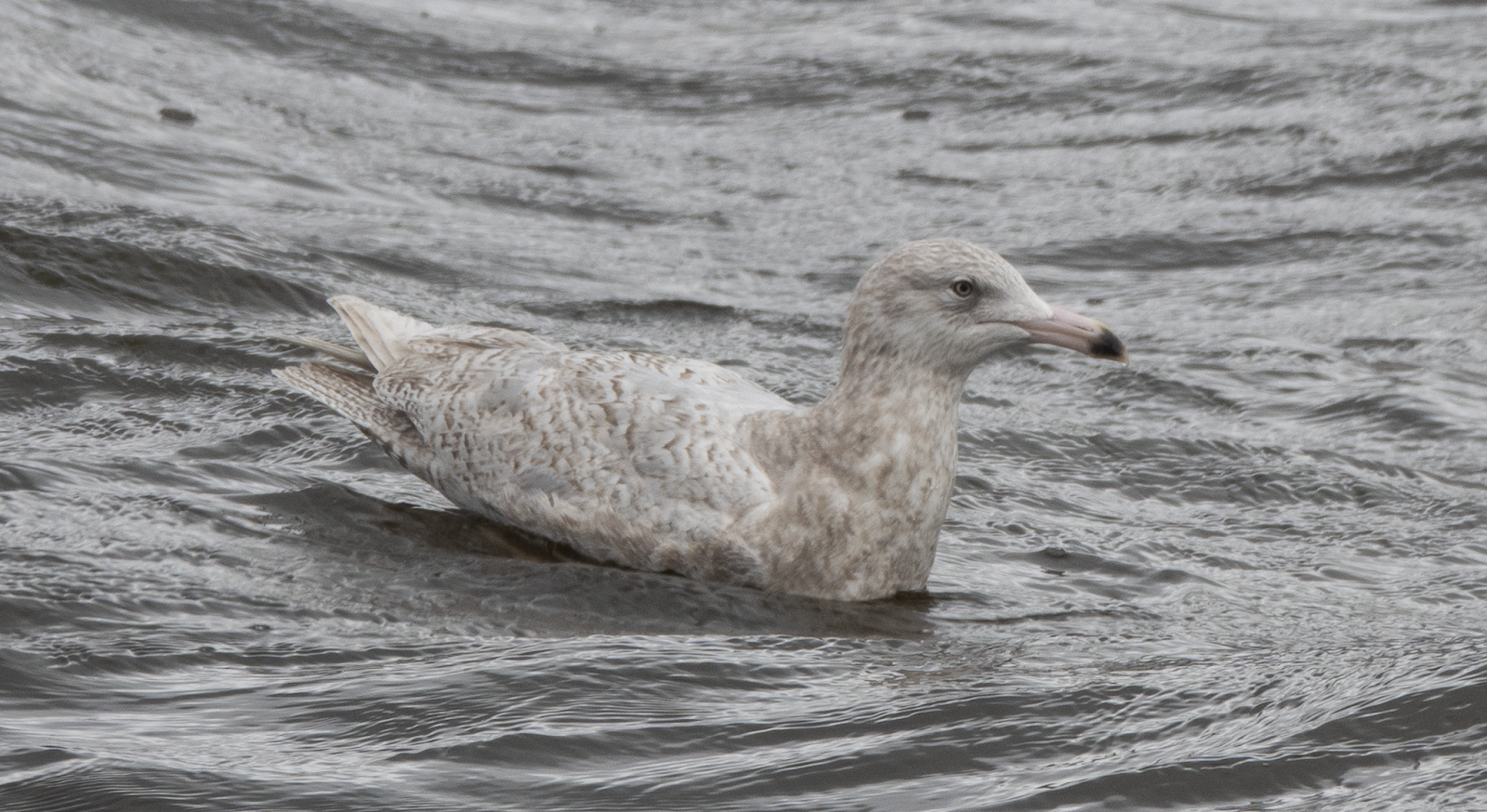
We reached Vlissingen, with it's harbour and ship yard around lunch time. Here we initially had a bit of a drive round in search of our quarry, but eventually located a 2nd winter Glaucous Gull, which showed down to a few metres, catching a Common Dab while we were there. In the same vicinity we had nice views of Herring Gull and Cormorant.


 Glaucous Gull


 Herring Gull


Cormorant


We had fish and chips in the harbour cafe and then gradually retraced our steps. At Middelburg we located a Red-breasted Goose among the Barnacle Geese, several Greater White-fronted Geese and a male Peregrine, which took a Common Starling in flight. On the other side of the town, Wietze found a private garden, where he had been tipped off that a Little Owl is roosting and we obtained a nice record shot of the bird, sitting in its barn. On the way back north, we had nice opportunities to photograph Dark-bellied Brent Geese and Little Egret.

Red-breasted Goose


Greater White-fronted Geese


Dark-bellied Brent Goose


Little Owl


Little Egret


On the way back, crossing back into South Holland at Oostvoorne, we got distant views of a Great Bustard, although, alas the bird is from a captive bred scheme and not tickable, but was still nice to see in a wild state. Canada Goose has recently been removed from the Dutch list since the Dutch authorities have decided that there have been no genuine vagrants, and don't qualify for the official rankings. A female sitting in the grass by the farm looked suitably unimpressed by its demotion.


Canada Goose


After a long day in the field, I was ready for some nosh and had a picnic in the hotel dining room with some hummus and dips and a not for the faint-hearted bottle of 10% abv Hertog Jan. This was a Quadrupel beer and was just what was needed for the chillies and garlic flavoured hummus.


Hic!


The Sunday was a full day, with lots of driving but quality birds all the way. 

We began with an adult Iceland Gull at Juliandorp in Noord Holland, which had been showing well around rooftops the previous day. Alas, it was now  loafing in a field but at some distance and unlike the previous day's Glaucous Gull, provided no photo opportunities. However, it was nice to get both white-wingers on the trip.

We continued north and made a couple of stops; firstly at the harbour at Den Oever, where there were stacks of Goldeneye and Great Crested Grebes but nothing of particular note. At Kornwerdzand on the border with Friesland, the situation was rather more interesting.  There was a raft of at least 1,500 Greater Scaup on the sea and by the harbour, single drake Smew and drake Goosander as well as the ever present mergansers, making it a three saw bill day.

 Goosander


 Greater Scaup


Smew


We made a stop at Leeuwarden looking for the resident Pied Crow, although it appeared to be having a day off, not showing around any of the houses where it normally resides. 

Undeterred, we pressed on to the oddly-named Koehool, for what was bird of the weekend. The site was no more than a patchwork of fields and a couple of farmsteads. After a bit of a run around we pinned down a 2nd calendar year Sabine's Gull, which had turned up two week's earlier. The bird had remained faithful to the same patch of fields and small stream. Though we had good views, the bird was favouring a field, which bordered a private garden and made anything beyond a record shot, impossible. 

Wietze decided to knock on the owner's front door, and in his best broken Frisian, asked if we might enter the garden in order to get better views. The man gave his permission and by standing in the corner of the field, the bird came pretty close. An amazing bird to see, and very unusual at this time of the year.


Sabine's Gull

Keeping one eye on the clock, we drove south east towards the border with Flevoland and connected with a Cattle Egret at Spanga, although like the Iceland Gull sat resolutely at the back of a field. We also saw a male Marsh Harrier here.

Further south near Meppel on the border of Drenthe and Overijssel we unsuccessfully searched for a White Pelican of unknown origin but were rewarded with a good views of several White Storks, who had set up home in the area.


White Stork

We finished off the day in Flevoland, unsuccessfully searching for Bewick's and Whooper Swans and in the failing light watched Black-tailed Godwits, which were coming into breeding plumage.

As we arrived at Maassluis, the news was that the government had closed all restaurants and cafes. However, Wietze knew of a Turkish kebab house that was 'off the grid.' None the less, the food was good and set me up for the evening. Wietze dropped me off at the railway station and I made the nine minute journey to Hoek van Holland for my sailing back to the UK.


Black-tailed Godwits


Many Thanks go to Wietze Janse, Hans Overduin and Menno Van Duijn

Saturday, 15 February 2020

Isles of Scilly 7th to 14th October


The pelagic in August had been my first visit to Scilly for 17 years and now I was here again. I normally travel and bird alone in the UK, but this time I was accompanied by my friend Jason Reece.  For various reasons, we travelled down to Penzance separately and I met Jason at the Queen's Hotel on the Friday evening. I had arrived in the afternoon and a little birding around Penzance had been quiet but at least produced a confiding Turnstone and a ridiculously approachable Rock Pipit.


Turnstone


Rock Pipit


Jason and I met for a drink in the bar and to sketch out some sort of a plan, but we opted to go with the flow.  I had joined the WhatsApp group and Jason had his pager. We concluded that a combination of media would give us the best chance to connect with anything that was about. 

The following morning was blustery with light rain, and Jason, not being a natural sailor was a little anxious about the crossing. However, I was able to allay his concerns somewhat, regaling him with my exploits from August and that once the seabirds appeared, he would forget about any maritime induced nausea.

After embarking from Penzance, we sat inside but with the weather clearing after half an hour we went on deck. It wasn't long before we were getting Manx, Sooty and Mediterranean Shearwaters. The birds were coming close enough even to draw the attention of some non-birders. It was really good! One Sooty Shearwater just past half way out came close enough for a passable record shot.

Sooty Shearwater

Arriving on Scilly, we checked the latest news. A Yellow-billed Cuckoo, a British tick for both of us had been seen on Lower Moors that morning and it was there that we headed after dropping off our luggage at The Wingletang.

We stared at a collection of bushes for the next three hours. They say you should never leave the site of a rarity, but when a Red-throated Pipit came on the pager for Peninnis, we decided we would give that a bash and least see a bird. 

It's not that far a yomp to the peninsular and the bird was at the town end, and was located right away, going in and out of furrows with a few Mippits for company. It was a tick for Jason, so at least one of us was happy. We headed back to Lower Moors only to hear that the cuckoo had showed, which was a bit of a blow. I had the feeling that this bird was going to give us the run around.

A brief diversion was provided in the form of a Smooth Stick Insect Clitarchus hookeri, which had decided to attach itself to Jason's coat. It was carefully extricated and 'posed' for photos before being released back onto the brambles.


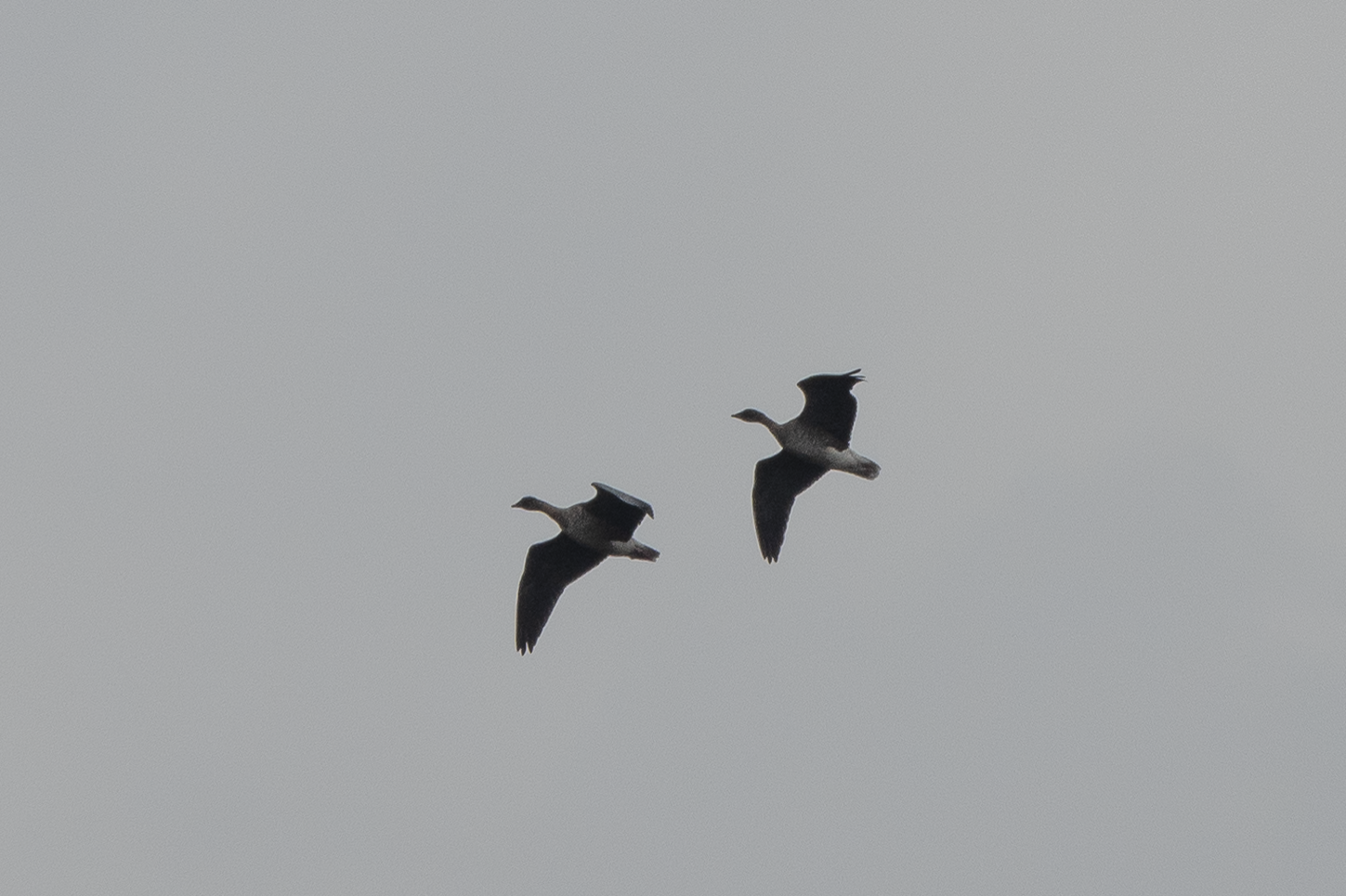
The next day, inevitably saw us back at Lower Moors and it's bushes but no cuckoo. We looked at our options, which included the Red-backed Shrike that had been at Old Town Churchyard since late September, but we decided to keep that one in reserve. Then news broke of a Blue-winged Teal at Porth Hellick. It wasn't too far to go, so we went there via Parting Carn, bagging the Pink-footed Geese en route and a rather obliging Barn Swallow.

 Barn Swallow


Pink-footed Geese

Turning up at Porth Hellick, there was a decent twitch for the teal, and there were conflicting reports; one that it had flown across the pool and the other that it had flown off at height. The consensus was that the bird was still around and after a short wait, the Blue-winged Teal flew in front of the Sussex hide and showed well with Eurasian Teal. The bird's bill somewhat intermediate between Garganey and Shoveler was distinctive. Then, as it preened it showed the blue lesser coverts.

 Blue-winged Teal (left)


Blue-winged Teal


By late morning we were wondering whether to search for the shrike, when news broke of a Red-eyed Vireo on Peninnis, on one of the permissive paths that are set up in October.

On arriving there, news was that the bird hadn't been seen for half an hour and we decided to make a tactical withdrawal and have coffee and cake at Old Town. En route, the Red-backed Shrike was perched out in the open on its ivy-clad tree.


I have to say, Old Town cafe was a disappointment and seems rather impoverished compared with how I remember it, back in the day. It wasn't helped by the fact that their dish washer was broken and we had to use paper cups and plates. I can't remember anything about the cake.

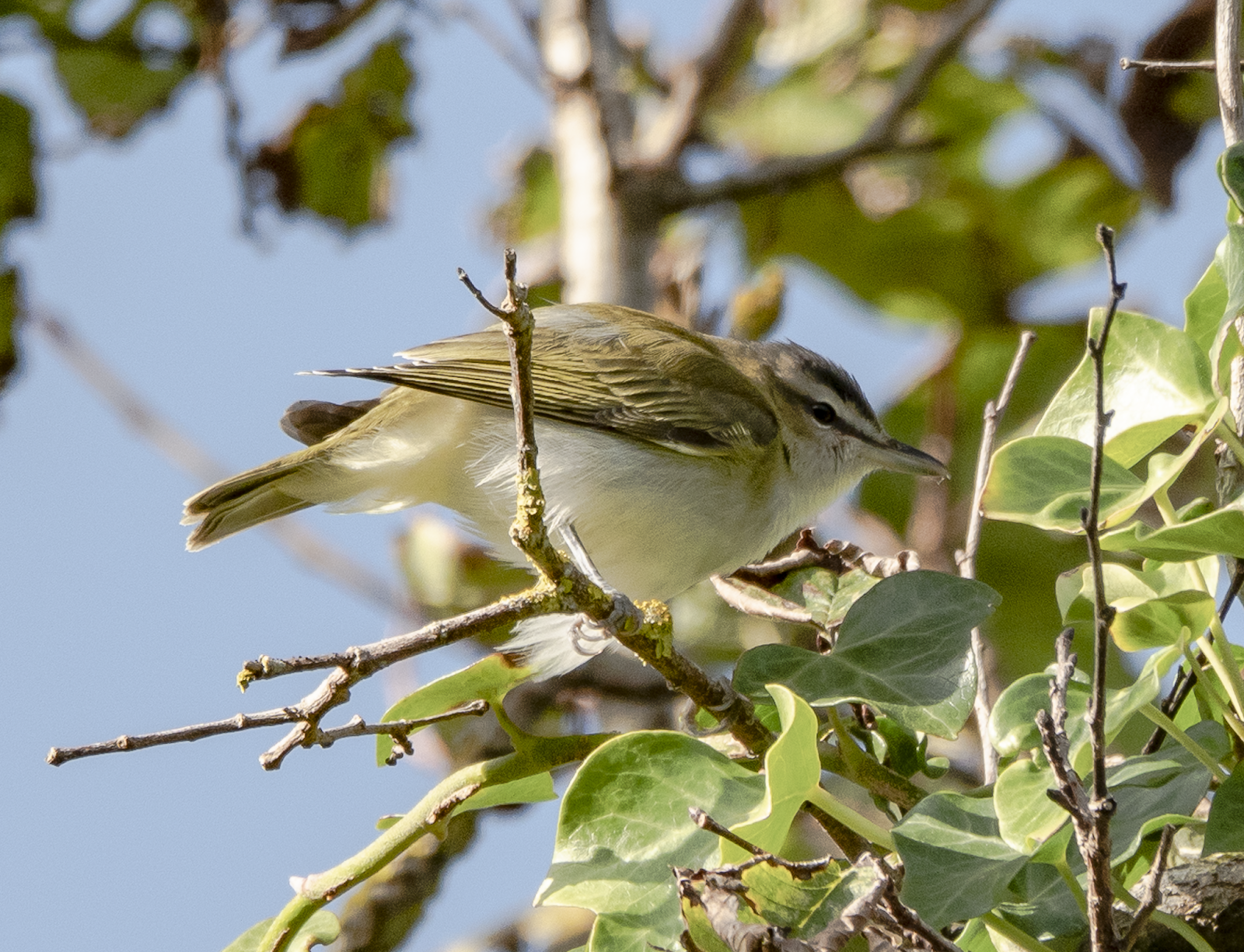
Back in the field, we returned to chez vireo. The bird had just been seen, but was currently out of view. It was quickly relocated and at close range, just below the canopy. The bird showed very well, 'Giving itself up' in Dick's words, and remained in the open, preening and roosting in full view for at least 30 minutes. A cracking bird and still an iconic Scilly species, even if they're not the mega that they once were.


Red-eyed Vireo


The 9th was an uneventful day. We gave the cuckoo a really good go in the morning, but there was nothing doing. We now assumed that it must have flown off or expired.

With nothing new in, we had a ramble around the island with a vague hope of locating the Blue Rock Thrush, which had been giving birders the runaround for a couple of weeks. In Old Town Churchyard the shrike was still in its tree and two Spotted Flycatchers were present, one of them perching up nicely.


Spotted Flycatcher

Nearby, in Old Town bay was a Greenshank and a Northern Wheatear on the rocks.

Greenshank


Northern Wheatear

We walked up past Old Town and to the airfield where a Dotterel had been reported, but had gone by the time we arrived. A female Stonechat was a nice diversion for a while and perched close-up.


At Porth Hellick beach, Jason, being an historian was eager to show me the monument placed in honour of the arrestingly-named Sir Cloudesley Shovell, whose ship foundered on the rocks in 1707. 

Moving on, we heard the Cetti's Warbler by Sussex hide and had a Yellow-browed Warbler by the road. 

Somehow we had got this far without any serious cakes, so with Longstone's a short walk away, we traversed the Tolkienesque Holy Vale and then up the path from the hamlet.

From my visit in August, I knew that Longstones served mean cakes and I wasn't disappointed. The peanut fudge cake was giving the Attenborough chocolate peanut stack some serious competition.

Peanut fudge cake

After our refreshments, Jason and I agreed to pursue the Block Rock Thrush at different locations. I retraced my steps in hope of relocating the bird at Giant's Castle, which seemed as good a place as any. A Shag was pleased to be snapped on Porth Hellick beach and at Giant's Castle I lingered to photograph Ringed Plover, in what was now perfect late afternoon light.


 Eurasian Shag


Ringed Plover

The 10th began calmly enough and Jason and I planned to visit Tresco in order to see the Short-toed Lark, which had been frequenting the heliport.

On the way to the quay we paused by the harbour wall, where two Med Gulls were loafing. A few well aimed pieces of bread lured the birds closer. The morsels were consumed by Herring Gulls, but at least enabled me to get a shot of a first winter Mediterranean Gull in flight.

Mediterranean Gull

We had tickets in hand, in the queue for Tresco when Jason's pager beeped. 'Swainson's Thrush Carreg Dhu Garden.' This was a British tick for Jason, and I hadn't seen one since the '87 Longstones bird. There was no question, the lark would have to wait. We headed back into town and when we were on the Strand, I bumped into my old friend Ken Spriggs from Leicestershire. There was a taxi bound for the airport, and we claimed force majeur, piling on, and were dropped off on Telegraph Road, at the end of the lane to the garden.

We joined the throng, which was assembled in a semi circle around the area where the bird had been seen. Two hours elapsed and there were no further sightings. I was ready to give up and then a message on WhatsApp alerted the fact that the Blue Rock Thrush was showing at Morning Point. I needed this for my British list, and Jason was happy to give it a go. 

We made a bee-line back into town as quickly as possible and negotiated the narrow passages at Sally Port and onto the Garrison Walls. Jason and I had become separated, but we reconnected east of the Woolpack battery. A couple of birders informed us the bird had just flown along the coast. Jason set up his scope and said, "I think I've got it!" I looked through the eye piece. It was a fair way off, but after a few seconds of processing, I realised I was looking at a Blue Rock Thrush.  We were joined by more birders, including county colleague Rob Hoare and the bird continued to feed among the rocks between our position and Morning Point. It flew a little closer and eventually we had fairly good views in the scope, but it was never close enough for a photo.

There was only one way to celebrate a new bird - cake!  We walked back into town and popped into Strudel in Town, which is hidden away off Thorofare. Jason plumped for the apple strudel and I went for the Russian cake. Now, Russian cake is something I remember from my childhood, a vodka-soaked marble cake. This was nothing like that and while a perfectly enjoyable dessert, was a little disappointing, simply because I had hoped to rekindle my youthful memories.

'Russian Cake'


Replete after our cake, we checked out Porthcressa Bay, where a Great Northern Diver was showing off shore. There was nothing mega, so we had a go at knocking off a Snow Bunting that had been reportedly showing down to a few feet along King Edward's Road. We located the bird initially at a puddle, but it flew up to the stone wall by the road and showed amazingly well, indifferent to our presence.

Snow Bunting


On the 11th we revived our plan to visit Tresco. It was a wet day and even with my weather app set to optimistic, we were going to get wet. Docking at New Grimsby, we walked the short distance to the air field. We located the Short-toed Lark immediately. The bird was never particularly close but by employing a little field craft I was able to get a record shot. More obliging was a male Stonechat near the Abbey gardens.

Short-toed Lark


Stonechat

With the aim to gain kudos at the log call, we set about counting the ducks on the Great Pool. The hide was particularly well positioned, as we entered it during a really heavy downpour. Counting everything as we went, including Wren and Dunnock we reached the New Inn. We thought we had had a decent morning, but while we were tucking into sticky toffee pudding, Will Wagstaff was finding Rustic Bunting and Red-eyed Vireo! 


Sticky toffee pudding


Back in St. Mary's and with the weather still a bit rubbish, we headed for Lower Moors, giving 'the cuckoo' a desultory 15 minutes and also failing to photograph a Spotted Crake, found by my Dutch friend Debby Doodeman which had apparently been walking around people's feet. I did however get some nice shots of Common Snipe from one of the hides and a Water Rail emerged from the reeds for long enough for a record shot.


 Common Snipe

Water Rail


Armed with our notes, we were stoked at the log call, scoring with our counts of ducks. When it came to Carrion Crow, Lucy announced that the threshold of significance was 40 and I weighed in with our count of 41 on Tresco. Get in!

The 12th was a day I won't forget in a hurry. It was during breakfast that news of a Convolvulus Hawk Moth Agrius convolvuli broke, the insect said to be resting on a telegraph post by Harry's Walls. I had always wanted to see one of these, so we walked there and found it still clinging to its post.


Convolvulus Hawk-moth


We had a plan to look for the Spotted Crake, but as we were chatting to Alison Allen, a message came through that the Yellow-billed Cuckoo had just been seen by my mate Paul Buxton at the Dump Clump. As this was a stone's throw from our current position, we hurried to the place. Alas, on arrival, no one on site knew exactly where the bird was, and with my Virgin signal not available, I couldn't contact Paul for better directions. For 20 minutes, we waded through the mud, seeing nothing. After all the rain, the Dump Clump was turning into the Great Grimpen Mire - and it was hard work. I stepped over a particularly thick bit of mud and looked back towards Lower Moors, when movement caught my eye. 

For a second with the naked eye, I assumed I had a Collared Dove. Raising my bins I focused on the bird. Rufous wing panel, long graduated tail, white underparts and curved two-tone bill. Yellow-billed Cuckoo!!! I blurted an expletive and 'I've got it!' 

Over the next ten minutes there was a bit of a scrum but Jason and a few other birders had the bird in the same place.

Afterwards, we connected with a Turtle Dove, which was consorting with Collared Doves by the Industrial Estate. Feeling that we were on a roll, it seemed like no better time than throw the dice again for the Spotted Crake.

There was a few birders by the little bridge along the path, and the crake had been seen briefly a few minutes earlier. As I was making space on my memory card the bird appeared on the path a few feet away. I was treated to a few minutes of the bird walking around, oblivious to its admiring crowd.


Spotted Crake


In the evening, Jason and I ate in the Atlantic. We had switched between there and the Mermaid. The latter was more like restaurant food, but the Atlantic served better beer and proper pub grub. 

Yours truly


Our last full day was the 13th. A White-rumped Sandpiper found the previous afternoon was reported as still present at Toll's Porth. As this is a bit of a yomp, we hailed a taxi that just happened to be going to Telegraph. We cut through the burial chamber and down to the coast. The bird was feeding among the tidewrack but owing to the lie of the land was difficult to approach, so I only managed a record shot. Also at this spot were two Ravens, one showing well as it patrolled the coast.

White-rumped Sandpiper


Raven

From Toll's Porth we walked back to Telegraph and then along Pungies Lane to Newford Duck Pond where a putative female Green-winged Teal had been present since the beginning of the month. The bird certainly was a good candidate and showed the width of cinnamon in the wing bar, suggestive of GWT. I understand that DNA analysis and further moult has established the bird as a drake Green-winged Teal. News from St, Martin's of a Rose-breasted Grosbeak was frustrating for Jason, as we were a long way from Hugh Town and wouldn't make the extra boat that was planned for there. I had seen one on Scilly, years ago, but wouldn't mind another, so we hoped it would stick.

Green-winged Teal


We headed south via Borough Farm and Holy Vale, where we found a Red-breasted Flycatcher. This was a catch up bird for me, as Jason had seen one earlier in the week at the Dump Clump, while I was elsewhere. 

After a good morning and a fair amount of walking, we paused for a break at Longstone's cafe, where cake of the day was chocolate roulade. A typically photogenic Song Thrush was just too smart to pass up, as I munched on my cake.

Song Thrush


Chocolate roulade

Jason was feeling bushwhacked, so he headed back to town, leaving me to explore. I spent the afternoon around Telegraph Lane, where I managed to bag a late Hobby, briefly and the third Whinchat of the day. I gave the White-rumped Sandpiper another go, but didn't feel comfortable getting any closer, but added Whimbrel to the week list along the beach.

Hobby


Whimbrel


On the 14th, our final morning, news broke early that the Rose-breasted Grosbeak was still at St. Martins by the art gallery. We breakfasted early, and headed for the boats, aiming to be the first in the queue. 

It was a sweaty up hill walk to the spot, but we didn't have to wait long for the bird to appear, showing itself twice in the open, if not awfully close. It was a quality bird with which to round off our trip.


Rose-breasted Grosbeak


The Rosy Grosser twitch